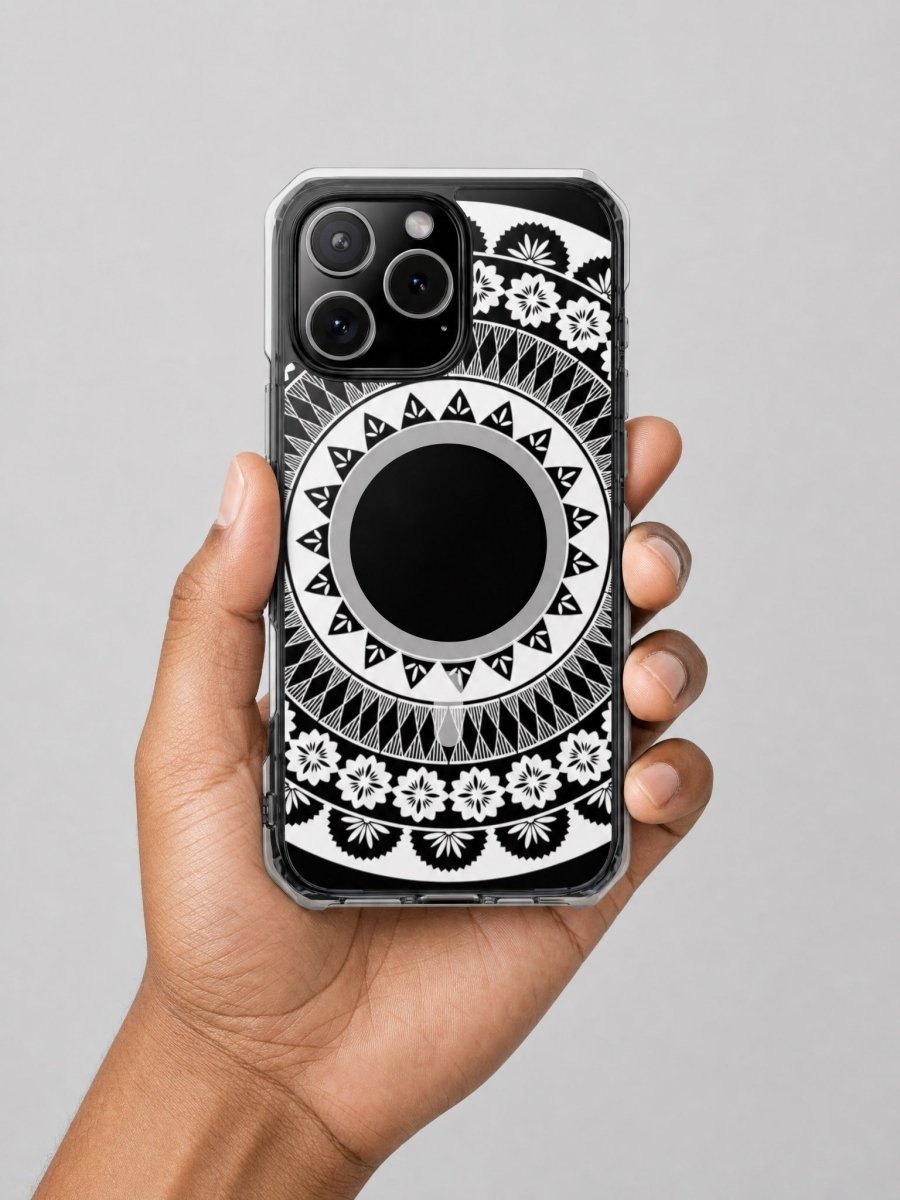
Fijian design is built on masi, the barkcloth Fijians have made and marked for centuries. The patterns are geometric, high contrast and read in black and rust, and they are not the same thing as Samoan siapo even though the two are cousins. If you are buying something Fijian for Fiji Day on 10 October or for Fijian Language Week, which runs 4 to 10 October 2026 in New Zealand, this is what the patterns mean and what is worth owning.
In this article
- What is masi?
- Fijian or Samoan?
- When to buy Fijian
- What to buy
- Wearing it respectfully
- Frequently asked questions
What is masi and what do the patterns mean?
Masi is Fijian barkcloth, made from the inner bark of the paper mulberry. The bark is stripped, soaked, beaten out into a wide sheet and then marked in black and rust brown using stencils and natural dyes. The result is a cloth used for ceremony: weddings, chiefly installations, births and funerals.
The patterns are geometric rather than pictorial. Triangles, zigzags, grids and repeated bands, laid out with strong symmetry and deliberate negative space. Different regions of Fiji mark masi differently, and the making has traditionally been women's work passed between generations.
Worth being straight about: the specific meanings of individual motifs vary by island and by family, and a lot of what circulates online as a fixed dictionary of Fijian symbols is invented. The honest description is that masi is ceremonial cloth carrying regional geometric traditions, not a decoder ring.
How is Fijian masi different from Samoan siapo?
They are related crafts across the same ocean, and the differences are real but not absolute.
| Fijian masi | Samoan siapo | |
|---|---|---|
| Cloth | Beaten paper mulberry bark | Beaten paper mulberry bark |
| Typical palette | Black and rust brown, high contrast | Brown, ochre and black, often softer |
| Pattern feel | Strong stencilled geometry, large blocks | Freehand and rubbed motifs, finer repeats |
| Method | Stencils are widely used | Rubbing over a carved board (upeti) is common |
| Use | Weddings, chiefly ceremony, funerals | Ceremony, gifting, fine mats context |
If you want the Samoan side in depth, the blog has a full piece on Samoan design patterns, and another on how the West Polynesian nations relate.
When do Fijians buy Fijian prints?
Three moments carry most of it. Fiji Day on 10 October marks independence from Britain in 1970 and is the biggest of the three in the diaspora. Fijian Language Week in New Zealand runs 4 to 10 October 2026 and lands in the same window, so the two reinforce each other. And the rugby, which needs no calendar.
The practical consequence is that the first two weeks of October are when Fijian print sells, and anything made to order needs three weeks of lead time before that.

The masi pattern and its reverse on two MagSafe clear cases, sold together for less than the two separately. One on the phone, one for when you want the change.
See the Fiji shelf →What is worth buying in a Fijian print?
Phone cases first, and not because they are cheap. A masi pattern is high contrast geometry, which is exactly what survives being shrunk to the back of a phone. A soft floral does not. A print that is built from hard lines and negative space still reads at that size.
Then anything that gets seen in public: a tote, a tee, a case. The value of wearing a Pacific pattern in Sydney or Auckland or Salt Lake City is the recognition, and recognition needs to happen at a distance.

Can you wear Fijian masi patterns if you are not Fijian?
A printed masi inspired pattern on a phone case or a tee is a commercial design, not a ceremonial cloth, and wearing one is not an offence. The distinction that matters is between a pattern and an object with a role.
Actual masi used in a wedding or a chiefly installation is a different category entirely. It is presented, it carries obligation, and it is not decoration. The same is true of Samoan fine mats. Nobody is asking you to avoid the pattern; they are asking you not to treat the ceremonial article as a soft furnishing.
Two practical courtesies. Buy from Pacific owned makers where you can, because the money then circulates in the communities the design came from. And learn one line about what you are wearing, so that when somebody asks you have an answer better than that you liked the look of it. There is more on the first point in why choose Pacific owned brands.
Nothing here is sitting in a warehouse. Each piece is printed and sewn after the order is placed, which has two consequences worth planning around. The good one is that there is no dead stock, so a print does not get discounted into landfill at the end of a season and sizes that sell slowly still exist. The inconvenient one is the production window: there are several days between you paying and anything being handed to a courier.
The practical rule is three weeks from order to door for Australia and New Zealand, and closer to four if it is crossing an ocean. Work backwards from the date you need it, not forwards from today. There is more on why the model works this way in why made to order is the future of sustainable fashion.
Frequently asked questions
What is masi in Fijian culture?
Masi is Fijian barkcloth made from beaten paper mulberry bark and marked in black and rust brown. It is used for weddings, chiefly ceremonies, births and funerals.
Is Fijian masi the same as Samoan siapo?
They are closely related but not the same. Both are beaten barkcloth, but Fijian masi leans on stencilled high contrast geometry while Samoan siapo more often uses rubbing over a carved board and a softer palette.
When is Fiji Day?
10 October, marking Fiji's independence from Britain in 1970. In New Zealand, Fijian Language Week runs 4 to 10 October 2026, in the same window.
Do Fijian patterns have fixed meanings?
Motifs vary by island and by family, and much of what circulates online as a fixed symbol dictionary is invented. Masi is best understood as regional ceremonial geometry rather than a set code.
Carry the masi
Fijian patterns on the things that get seen: cases, totes and tees.
Shop the Fiji shelf →Made to order. Order three weeks before Fiji Day on 10 October.
Read next: Samoan Design Patterns · Samoan or Polynesian?


