Short answer: Gagana Samoa is the Samoan language, the living heart of Fa'a Samoa, the Samoan way of life. It is spoken by over 110,000 people in New Zealand alone, making it the third most spoken language in the country. It uses a 14-letter alafapeta (alphabet) plus the glottal stop, has two distinct registers for everyday and formal speech, and carries centuries of cultural identity in every phrase. This beginner's guide covers the alphabet, the two registers, essential phrases, and where to start learning.
Language is memory made audible. For Samoan people, Gagana Samoa is far more than a tool for communication. It is the framework through which culture, identity, kinship, and respect pass across generations. Every greeting, every proverb, every silence in a formal ceremony carries the weight of Fa'a Samoa.
New Zealand's 2023 census recorded 110,541 Samoan speakers, the third most spoken language in the country after English and te reo Maori. Australia's 2021 census counted 49,025 Samoan speakers. The global diaspora keeps the language alive and growing.
In this guide
- What is Gagana Samoa?
- How does the Samoan alphabet work?
- What are the formal and informal registers?
- Essential Gagana Samoa phrases for beginners
- Why does Gagana Samoa matter in the diaspora?
- How do you start learning Gagana Samoa?
- Frequently asked questions
What is Gagana Samoa?
Gagana Samoa is the official language of the Independent State of Samoa and is widely spoken in American Samoa, New Zealand, Australia, and the United States. It belongs to the Polynesian branch of the Austronesian language family, sharing roots with Hawaiian, Tongan, and other Pacific languages.
Samoan is the most widely spoken Polynesian language by number of native speakers. The total worldwide speaker count is estimated between 430,000 and 510,000, depending on how diaspora speakers are counted, and a large share of those speakers live outside the Samoan Islands.
The word gagana means language or tongue, and Samoa refers to the islands and the people. So Gagana Samoa simply means the language of Samoa. But that translation says nothing about the depth and beauty of what the language carries.
How does the Samoan alphabet work?
Gagana Samoa uses a 14-letter alphabet, the alafapeta, plus the glottal stop. Each letter has a single, fixed pronunciation, making it one of the most phonetically consistent languages in the world. Once you learn the sounds, you can read any Samoan word out loud correctly.
Vowels
The five vowels A, E, I, O, and U are pronounced like Spanish or Italian vowels. A sounds like ah, E like eh in bed, I like ee, O like oh, and U like oo in boot. Vowel sounds in Samoan are always clear and distinct, even side by side.
Consonants
The nine consonants are F, G, L, M, N, P, S, T, and V. There is no B, C, D, H, J, K, Q, R, W, X, Y, or Z in traditional Gagana Samoa. This gives the language its smooth, flowing sound.
The glottal stop and macrons
Two symbols are essential for correct meaning:
- The glottal stop (written as an apostrophe) is a brief pause in the throat, like the pause in uh-oh. It changes meaning completely. For example, alo means to paddle a canoe, but 'alo means to dodge or avoid.
- Macrons (fa'amamafa) are lines above vowels: a, e, i, o, u. They mark a long vowel sound, which also changes meaning.
This is why written Samoan should always use proper diacritical marks. Dropping them can change a word entirely.
What are the formal and informal registers?
Gagana Samoa has two distinct speech registers. Everyday speech, Gagana Masani, is used in casual conversation with family and peers. Formal speech, Gagana Fa'aaloalo or Gagana Fa'amatai, is the language of respect used when addressing a matai (chief), an elder, or in ceremonial contexts. The two registers use entirely different vocabulary for the same concepts.
For example, in everyday Gagana Masani you use a common word for eat. But when speaking to a matai, you use the honorific form, a completely different word. This is not just politeness. It reflects the social architecture of Fa'a Samoa, where the relationship between people determines how they speak to each other.
Learning the formal register takes years of cultural immersion. For beginners, mastering the everyday register is the right place to start. But understanding that the formal register exists, and why it matters, is part of understanding Samoan culture itself.
Essential Gagana Samoa phrases for beginners
Here are foundational phrases to begin your Gagana Samoa journey. Each opens a door to deeper cultural understanding.
| Samoan | Meaning |
|---|---|
| Talofa | Hello (the most widely known Samoan word) |
| Fa'afetai | Thank you |
| Fa'afetai tele lava | Thank you very much |
| 'Ae / Leai | Yes / No |
| Manuia | Bless you, or good luck |
| Tofa soifua | Goodbye (sleep in good health) |
| Malo le soifua | Greetings to your good health |
Even learning a handful of these shows deep respect for Samoan culture and will be appreciated by any Samoan person you meet. For the full picture on the two most important everyday phrases, see our guides on how to say hello in Samoan and how to say thank you with fa'afetai.
Why does Gagana Samoa matter in the diaspora?
For Samoan families in New Zealand, Australia, and the United States, Gagana Samoa is a lifeline to identity. Speaking the language connects second and third-generation Samoans to their aiga (extended family), their village traditions, and their spiritual life. Without language, much of that connection fades.
The Ministry for Pacific Peoples in New Zealand has made Gagana Samoa preservation a national priority. Vaiaso o le Gagana Samoa, Samoan Language Week, was the first Pacific language week celebrated in New Zealand, beginning in 2007, and it grows every year. In 2024 the theme was Tautua i le alofa, manuia le lumana'i, meaning serve in love for a blessed future. The week celebrates not just words, but the values carried within them.
At The Koko Samoa we feel this every day. As a Samoan-owned brand built by and for the diaspora, we know language, design, and culture are inseparable. Our Samoan-designed clothing carries the same stories Gagana Samoa carries. Patterns, colours, and words are all ways of saying: we are still here, and this is who we are.

A printable way for tamaiti to meet the language early, colouring in a Samoan word and the story behind it.
How do you start learning Gagana Samoa?
You can start today, even without a formal class. The best approach combines structured learning with cultural immersion:
- Community language groups: most major Samoan diaspora cities have church-based and community language groups, often the most natural learning environments.
- Aoga Amata: Samoan early childhood language centres operate across New Zealand. Attending their public events is a great way to hear natural spoken Gagana Samoa.
- Online resources: the Te Papa Samoan Language Week teaching resource is a well-structured free starting point.
- Apps: Duolingo now has basic Samoan content, and community-built Anki flashcard decks cover core vocabulary.
- Immersion: watch Samoan television, listen to Samoan radio, attend church services in Gagana Samoa if you can. Language lives in context.
The most important thing is consistency. Even ten minutes of daily practice builds familiarity with the sounds and patterns over time. And if you have Samoan family members who speak the language, ask them to speak it with you. That request alone is a profound act of cultural respect.
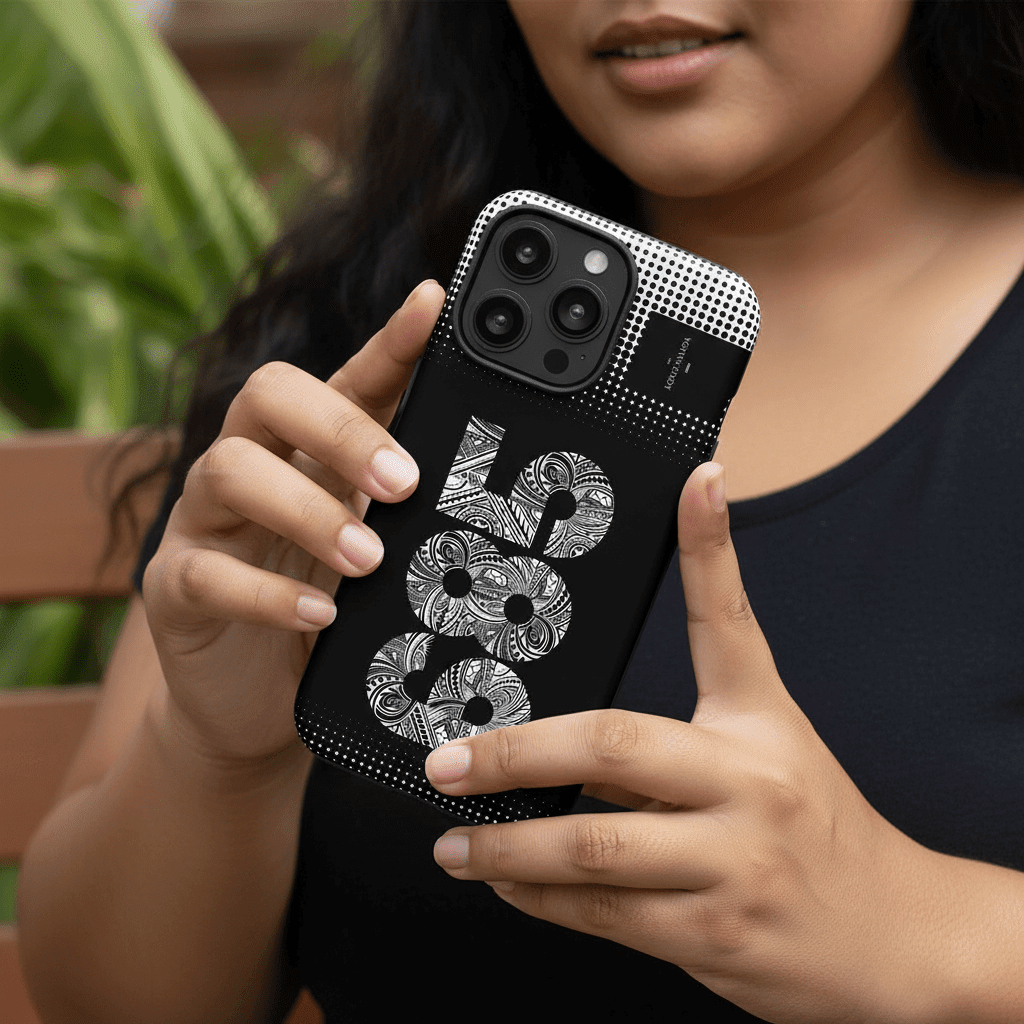
Beyond language, you can connect with the culture through design. Our Samoan phone cases carry tatau-inspired patterns, and the 685 case wears Samoa's country code like a quiet password between Islanders. Every product tells a story the same way Gagana Samoa does.
Browse the full set of printable sheets, each one pairing a Samoan word with something tamaiti can colour in and keep.
Browse the full apparel collection for more Samoan word-art and tatau-inspired designs that carry the language with you.
The Samoan Language Week guide is the practical companion: when Language Week falls, how workplaces mark it well, and what to wear if you do not speak it yet.
Frequently asked questions
What does Gagana Samoa mean?
Gagana Samoa means the Samoan language. The word gagana means language or tongue, and Samoa refers to the islands and people. Together it literally means the tongue of Samoa. It is an official language of both the Independent State of Samoa and American Samoa.
How many people speak Gagana Samoa worldwide?
Global estimates range from 430,000 to 510,000 speakers, depending on how diaspora speakers are counted. New Zealand's 2023 census recorded over 110,000 Samoan speakers, making Gagana Samoa the third most spoken language in the country. Australia has approximately 49,000 speakers, and the United States has a significant Samoan-speaking community, particularly in Hawaii, California, and Utah.
Is Gagana Samoa hard to learn?
The alphabet and pronunciation are actually easier than English, because each letter has a single fixed sound. The challenges come in the two speech registers (everyday and formal), the glottal stop and macrons that change word meanings, and the cultural context that shapes when and how to use different expressions.
What is the difference between everyday and formal Gagana Samoa?
Gagana Samoa has two registers. Everyday speech, Gagana Masani, is used in casual conversation with family and peers. Formal speech, Gagana Fa'aaloalo or Gagana Fa'amatai, is used when addressing a matai (chief), an elder, or in ceremonial contexts. The formal register uses entirely different vocabulary for the same concepts, reflecting the social structure of Fa'a Samoa.
What is Vaiaso o le Gagana Samoa?
Vaiaso o le Gagana Samoa is Samoan Language Week, celebrated annually in New Zealand and increasingly in Australia. It was the first Pacific language week established in New Zealand, beginning in 2007. In 2024 the theme was Tautua i le alofa, manuia le lumana'i, meaning serve in love for a blessed future. The week includes events in schools, churches, community centres, and cultural institutions.
Teach the tamaiti gagana Samoa
Printable Learn and Colour Sheets that pair Samoan words with art, an easy first step into the language for kids.
Browse the sheets →Made-to-order by a Samoan-owned brand. Worldwide shipping.


