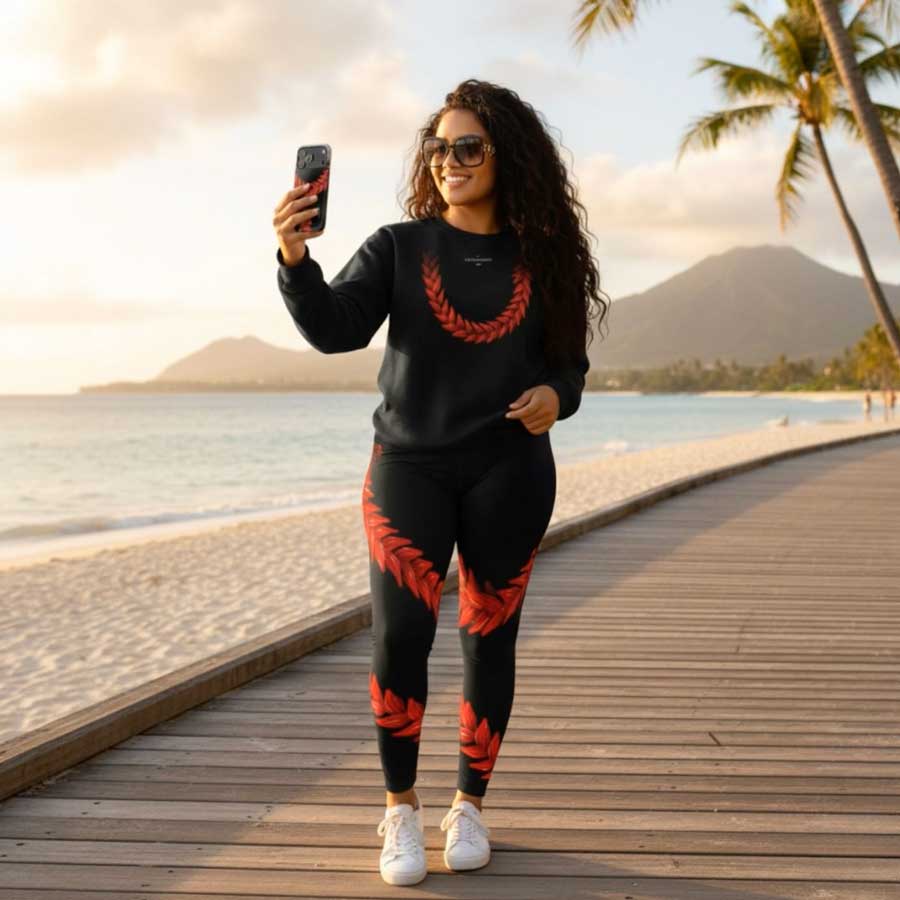
TL;DR: Polynesian fashion is one of the most visually distinctive and culturally rich design traditions in the world. It spans the tatau-inspired geometric prints of Samoa and Tonga, the intricate tapa cloth patterns of Tonga and Fiji, the kapa cloth designs of Hawaii, and the ta moko facial tattooing tradition of the Maori. This guide maps the Polynesian fashion landscape: its traditions, its contemporary expressions, and where to find authentic Pacific fashion today.
Introduction
Polynesia is the eastern triangle of the Pacific, defined by Hawaii to the north, New Zealand (Aotearoa) to the southwest, and Easter Island (Rapa Nui) to the southeast. Within this vast region — covering more ocean than any other on Earth — a family of related cultures developed distinct but interconnected visual traditions over thousands of years of Pacific navigation and settlement.
Today, "Polynesian fashion" encompasses everything from traditional ceremonial garments to contemporary diaspora streetwear. Understanding the breadth of this landscape helps consumers, fashion enthusiasts, and Pacific communities engage with it more thoughtfully.
The Polynesian Fashion Traditions
Samoan Fashion
Samoan fashion draws primarily on two traditions: the tatau (tattoo) and siapo (bark cloth). Tatau-inspired geometric patterns — dense, precise, and deeply meaningful — are the dominant visual language of contemporary Samoan-inspired design. The pe'a (male tattoo) and malu (female tattoo) provide an inexhaustible vocabulary of triangles, spines, centipede motifs, and ocean references that translate powerfully onto clothing and accessories.
Traditional Samoan dress includes the lavalava (wrapped cloth), puletasi (women's formal matched outfit), and ie faitaga (men's formal lavalava). The ie toga (fine mat) is the most prestigious ceremonial textile. Contemporary Samoan fashion, particularly from diaspora communities in New Zealand and Australia, combines these traditional foundations with modern streetwear aesthetics.
Tongan Fashion
Tongan fashion shares significant overlap with Samoan tradition — both belong to the western Polynesian cultural sphere — but has distinctive features. Tongan tapa cloth (ngatu) uses bolder, more geometric patterns than Samoan siapo, often in black on natural bark cloth. The traditional Tongan tupeinu (wraparound skirt) and ta'ovala (woven mat worn around the waist) are central to formal dress.
Contemporary Tongan-inspired fashion increasingly draws on ngatu patterns in print form, producing clothing that carries Tongan visual identity into modern diaspora wardrobes.
Hawaiian Fashion
Hawaiian fashion is perhaps the most globally recognised Polynesian fashion tradition, largely due to the aloha shirt (Hawaiian shirt) which became a global casual wear phenomenon in the twentieth century. Behind the commercial proliferation of Hawaiian prints is a sophisticated indigenous tradition: Hawaiian kapa cloth (bark cloth), the kakau tattooing tradition, and the visual vocabulary of native Hawaiian arts.
Contemporary Hawaiian fashion navigates a complex landscape: balancing the global commercialisation of Hawaiian aesthetics with the revival of indigenous Hawaiian cultural expression. Authentic Hawaiian fashion from Native Hawaiian designers draws on deep cultural knowledge rather than on the tourist-oriented aloha shirt tradition.
Maori Fashion (Aotearoa New Zealand)
Maori fashion is experiencing a significant global moment. Designers like Toi Ngā Puna Wairua, Annah Stretton's Maori collaborations, and the surge of Maori-designed streetwear have brought ta moko (facial tattooing) patterns, koru (spiral) motifs, and kowhaiwhai (rafter painting) designs into international fashion consciousness.
The 2019 Met Gala appearance of New Zealand's exhibition featuring Maori design, and the increasing visibility of Maori cultural expression in mainstream New Zealand media, have accelerated this international recognition. Maori fashion is now a significant design force with global reach.
Fijian Fashion
Fijian fashion draws on both Melanesian and Polynesian design traditions, reflecting Fiji's position at the intersection of these two cultural spheres. Masi (Fijian bark cloth), the bula shirt (Fiji's equivalent to the aloha shirt), and traditional Fijian weaving patterns provide the visual foundations for contemporary Fijian fashion. Fijian-owned brands are increasingly producing clothing that carries masi-inspired patterns and other Fijian visual elements.
What Pacific Fashion Traditions Share
Across the diversity of Polynesian and Pacific fashion traditions, several features are broadly shared:
- Geometric design language: All Polynesian design traditions use geometric forms as primary visual vocabulary. The specific shapes, their meanings, and their compositional rules vary by culture, but the geometric orientation is universal.
- Body as cultural canvas: The tattooing traditions of Polynesia treat the body itself as the primary design surface. Clothing that extends this visual language onto fabric is following a deep cultural logic.
- Natural materials and origins: Traditional Pacific textiles (tapa, bark cloth, woven mats) are made from natural materials. Contemporary Pacific fashion often references these materials' colours and textures even when using modern fabrics.
- Community and ceremonial function: Traditional Pacific garments and adornments are not individual fashion statements but social communications: markers of status, occasion, family identity, and cultural belonging.
Where to Find Authentic Polynesian Fashion
The most important principle for finding authentic Polynesian fashion is to look for Pacific-owned brands. Cultural knowledge, community accountability, and genuine design depth are only reliably present when the brand ownership reflects the cultural traditions being expressed.
Key places to find authentic Pacific fashion:
- Pacific Island cultural festivals: Polyfest (Auckland), the Pasifika Festival (Auckland), Pacific Harmony events (Australia), and Pacific Island cultural events in the United States are the best places to discover Pacific-owned fashion brands.
- Pacific community online networks: Social media groups and community pages dedicated to Pacific Island communities in New Zealand, Australia, and the United States actively recommend Pacific-owned brands.
- Samoan-owned online stores: The Koko Samoa (thekokosamoa.com.au) is a Samoan-owned brand producing made-to-order clothing and accessories with authentic Polynesian design.
At The Koko Samoa, our clothing collection draws on Samoan and Polynesian visual traditions to create everyday wear for diaspora communities. Our designs are rooted in the tatau and siapo traditions of Samoa. Explore our full collection and read more on our culture blog.
The Contemporary Polynesian Fashion Scene
The past decade has seen an explosion of Pacific creative expression in fashion. Driven by the Pasifika diaspora in New Zealand and Australia — now the largest Pacific populations outside the Pacific islands themselves — a new generation of Pacific designers is producing work that is simultaneously deeply rooted and entirely contemporary.
This work is being seen internationally. Pacific models are gaining visibility in mainstream fashion. Pacific designers are presenting at New Zealand Fashion Week. The visual language of Polynesian design is influencing sportswear, activewear, and streetwear brands globally.
The challenge for this moment is to ensure that this visibility benefits Pacific communities rather than simply exploiting Pacific aesthetics. The answer, consistently, is to support Pacific-owned brands that carry the cultural knowledge and community accountability that authentic Polynesian fashion demands.
Conclusion
Polynesian fashion is one of the great design traditions of the world. Its geometric precision, its deep connection to body, identity, and community, and its three-thousand-year history of development across the Pacific give it a visual richness and cultural depth that few other traditions can match. As it enters a new period of global visibility, the most important thing that consumers, supporters, and cultural enthusiasts can do is engage with it through Pacific-owned channels, with Pacific cultural knowledge as the guide.
How to choose and size a Samoan hoodie goes deeper on the one garment most people buy first, including how to measure yourself properly for it.
Frequently Asked Questions
What is Polynesian fashion?
Polynesian fashion encompasses the traditional and contemporary clothing, textiles, and adornment traditions of the Polynesian peoples of the Pacific: Samoans, Tongans, Hawaiians, Maori, Cook Islanders, Niueans, Tahitians, and others. It ranges from traditional ceremonial garments and tattooing traditions to contemporary Pacific-inspired streetwear and diaspora fashion.
What are the main design traditions in Polynesian fashion?
The main design traditions include Samoan tatau (tattoo) and siapo (bark cloth) geometric patterns; Tongan ngatu (tapa cloth) designs; Hawaiian kapa cloth and kakau tattooing patterns; Maori ta moko and kowhaiwhai designs; and Fijian masi patterns. All share a geometric visual vocabulary but each culture has distinct motifs and meanings.
What is the difference between Samoan and Hawaiian fashion?
Samoan fashion draws primarily on the tatau geometric tradition and siapo bark cloth patterns, with formal dress centred on the lavalava, puletasi, and ie faitaga. Hawaiian fashion draws on kapa cloth patterns and the kakau tattooing tradition, but is also heavily influenced by the commercial aloha shirt tradition. Both are Polynesian but represent distinct cultural design vocabularies.
Where can I buy authentic Polynesian clothing?
Buy from Pacific-owned brands. The Koko Samoa (thekokosamoa.com.au) is a Samoan-owned brand making authentic Polynesian-inspired clothing. Pacific Island cultural festivals in New Zealand, Australia, and the United States are excellent places to discover Pacific-owned fashion brands directly.
Is it cultural appropriation to wear Polynesian fashion?
The key distinction is between buying from Pacific-owned brands with cultural knowledge (respectful) versus buying generic Pacific-looking prints from non-Pacific fast fashion brands (appropriation). Wearing Samoan-designed clothing from a Samoan-owned brand with cultural awareness is a form of respectful engagement with Pacific culture.


