Short answer: Australia and New Zealand are home to two of the world's largest Samoan diaspora populations. New Zealand has roughly 180,000 people of Samoan ethnicity, with South Auckland holding more Samoans than most cities in Samoa itself, while Australia has around 45,000, concentrated in western Sydney. Despite living far from the islands, Samoan communities maintain Fa'a Samoa through aiga networks, church, language, tatau, and Pacific festivals.
Samoans have always been a people of the sea. That spirit of movement carried them to New Zealand, Australia, and the United States from the mid-twentieth century onward, and they brought their culture with them. Unlike many migrant groups, Samoan communities have kept an extraordinary degree of cultural continuity. Here is who they are, where they live, and how they keep Fa'a Samoa alive.
In this guide
- Where is the largest Samoan community in New Zealand?
- How many Samoans live in Australia?
- Samoan communities across both countries at a glance
- How does Fa'a Samoa survive abroad?
- Tatau: identity written on the body
- Fashion and cultural expression in the diaspora
- Pacific festivals: where community comes together
- Frequently asked questions
Where is the largest Samoan community in New Zealand?
New Zealand holds the largest Samoan population outside Samoa itself. The 2023 census counted approximately 180,000 people of Samoan ethnicity, making Samoans the largest Pacific ethnic group in the country.
Samoan migration to New Zealand began in earnest after World War Two, when the government recruited Pacific labour for post-war industry. The community grew through family sponsorship, and by the 1970s and 1980s, South Auckland had become home to one of the densest concentrations of Pacific peoples anywhere in the world. Today, suburbs such as Mangere, Otara, Papatoetoe, and Manukau are cultural heartlands. An important shift is the rise of New Zealand-born Samoans, who are now the majority, navigating a dual identity that blends Samoan heritage with Kiwi culture. For more on the language that anchors this community, see our guide to Gagana Samoa.
How many Samoans live in Australia?
Australia's Samoan population is smaller than New Zealand's but has grown significantly over the past three decades. The 2021 census recorded approximately 45,000 people of Samoan ancestry, with the true number likely higher when accounting for multiple Pacific heritages.
Sydney holds the largest Samoan community in Australia, with significant populations in the western suburbs including Blacktown, Mount Druitt, Fairfield, and Liverpool. Brisbane, Melbourne, and Canberra also have established communities. Australia's Pacific Australia Labour Mobility (PALM) scheme has more recently opened pathways for Samoan workers, many of whom settle permanently. The Australian Samoan community is heavily concentrated in faith communities, with churches serving as the primary social institution for most families.
Samoan communities across both countries at a glance
| New Zealand | Australia | |
|---|---|---|
| Samoan population | ~180,000 (2023 census) | ~45,000 (2021 census) |
| Main hubs | South Auckland: Mangere, Otara, Manukau, Papatoetoe | Western Sydney, plus Brisbane, Melbourne, Canberra |
| Big festival | Pasifika Festival, Auckland (200,000+ visitors) | Parramasala and community-organised events |
| Language support | Samoan Language Week, Pacific-language radio, schools | Church-based and community language programs |
How does Fa'a Samoa survive abroad?
What makes the Samoan diaspora remarkable is how faithfully Fa'a Samoa has been maintained across generations. Several pillars sustain it.
Aiga, the extended family network, is the foundation of Samoan social life. It includes grandparents, aunts, uncles, cousins, and community members incorporated through obligation and affection. In both countries, family members often live close together, sharing resources and caregiving. Money is sent back to family in Samoa regularly, and these remittances represent a significant proportion of Samoa's GDP.
Church is a central expression of Samoan cultural identity, not just religious practice. In Auckland and Sydney, Samoan churches conduct services in Gagana Samoa, run Sunday schools that teach language and culture, and organise the major social events of the community calendar.
The matai system, Samoa's traditional chiefly governance structure, has extended into the diaspora. Families continue to recognise matai titles, hold fono (family councils), and make collective decisions according to traditional protocol. Our article on the Samoan matai system and fa'amatai explains how this ancient structure shapes urban life. Gagana Samoa is maintained through church services, community radio, and Saturday language schools, with New Zealand especially proactive. Our guide to Samoan Language Week explains why this annual celebration matters.
Tatau: identity written on the body
The Samoan tatau tradition has not only survived in the diaspora but flourished. Tattoo artists practise in Auckland, Sydney, Melbourne, and Brisbane, and demand for traditional pe'a (male tatau) and malu (female tatau) has grown among diaspora youth seeking a tangible connection to their heritage.
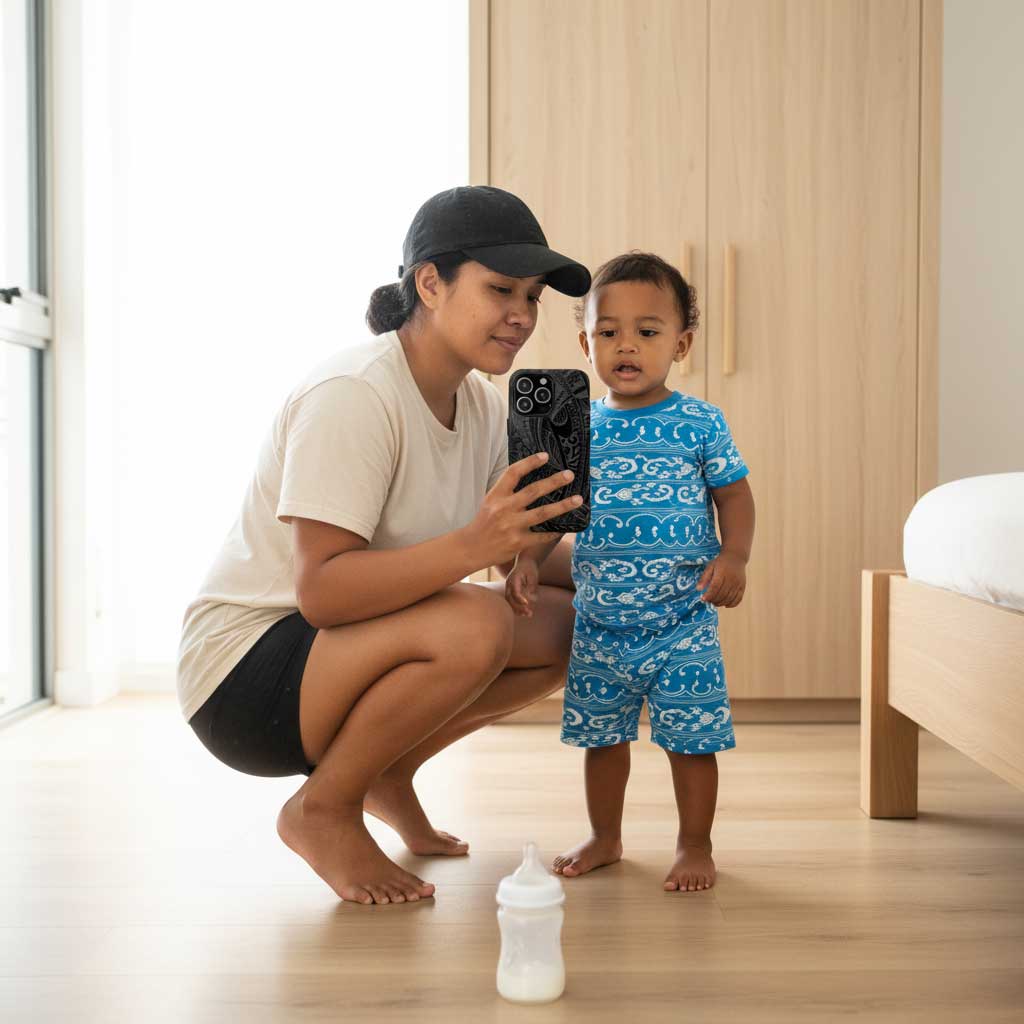
For many second and third-generation Samoans, receiving a tatau is a profound act of cultural affirmation: a decision to claim Samoan identity openly, honour ancestors, and carry the stories of the aiga on the body for life. For most of the diaspora, though, the everyday way to carry that identity is simpler. A design worn on a tee, or a country code on a phone you check fifty times a day.

685 is Samoa's dialling code. In Sydney or Auckland, it is a quiet way to say where home is, without saying a word.
Fashion and cultural expression in the diaspora
Fashion has become an important arena for Samoan cultural expression. Traditional garments like the ie faitaga and the puletasi remain worn at church, funerals, weddings, and celebrations. But Samoan-inspired streetwear has also entered everyday wardrobes, with tatau-derived patterns and Pacific prints finding their place in youth culture across both countries.
Samoan-owned brands play a role here. Rather than letting Pacific aesthetics be appropriated by fast-fashion companies with no connection to the community, Samoan designers create clothing that reflects genuine cultural knowledge and gives back. Our complete guide to Samoan fashion covers the full spectrum, and our guide to why to choose Samoan-owned brands explains the difference it makes.

Born in Mangere or Mount Druitt, still 100% Samoan. A heavyweight tee that says it plainly at the next family gathering.
Pacific festivals: where community comes together
Festivals are one of the most visible expressions of Samoan and Pacific culture. The Pasifika Festival in Auckland is the world's largest Pacific cultural festival, attracting over 200,000 visitors each year, held in March with villages representing each Pacific nation. The Samoan village is always one of the largest and most visited.
In Sydney, the Parramasala festival and various community-organised events bring Pacific culture to public spaces, with Brisbane, Melbourne, and Canberra each running cultural events through the year. Samoan Independence Day, celebrated on 1 June, is also marked across the diaspora with church services and community gatherings. Our article on Samoan Independence Day covers its history and meaning.
The Samoan Language Week guide covers the one week a year when speaking gagana Samoa in public feels normal rather than brave, and what to wear for it.
Frequently asked questions
How many Samoans live in Australia?
The 2021 Australian census recorded approximately 45,000 people of Samoan ancestry in Australia, though estimates accounting for those who identify with multiple Pacific heritages suggest the true figure may be higher. Sydney's western suburbs have the largest concentration, with significant communities also in Brisbane, Melbourne, and Canberra.
Where is the largest Samoan community in New Zealand?
South Auckland, particularly suburbs like Mangere, Otara, Manukau, and Papatoetoe, holds the largest concentration of Samoans in New Zealand. New Zealand is home to approximately 180,000 people of Samoan ethnicity, making it the country with the largest Samoan population outside Samoa itself.
Do Samoans in Australia and New Zealand still speak Samoan?
Yes, many do, particularly first-generation migrants and those raised in strongly Samoan church and family environments. However, language maintenance varies significantly across generations. New Zealand has more institutional support for Pacific languages, including Vaiaso o le Gagana Samoa (Samoan Language Week), Pacific-language radio, and community language schools. Language retention is a known challenge for third-generation and beyond.
What is the Pasifika Festival?
The Pasifika Festival is an annual Pacific cultural festival held in Auckland, New Zealand, typically in March. It is the world's largest Pacific cultural event, attracting over 200,000 visitors. The festival features cultural villages from Pacific nations including Samoa, Tonga, Fiji, Niue, the Cook Islands, and Tokelau, with traditional food, music, dance, crafts, and cultural demonstrations.
How do Samoan communities maintain Fa'a Samoa abroad?
Samoan communities maintain Fa'a Samoa through several overlapping institutions: the aiga (extended family) network that provides mutual support and enforces cultural obligations; the church, which conducts services in Gagana Samoa and runs cultural programs; the matai system, which continues to operate in diaspora form through family councils and title recognition; Saturday language schools and community language programs; and cultural events such as Pacific festivals, wedding and funeral protocols, and annual celebrations like Samoan Independence Day.
Carry home, wherever you live
Tatau-led tees, hoodies, and phone cases for the Samoan diaspora across Australia, New Zealand, and beyond.
Shop the collection →Made-to-order by a Samoan-owned brand. Worldwide shipping.


